
B
O
S
S
A
U
T
O
Loading
Injection Molding Machine Tonnage: How to Calculate the Right Tonnage
28
Sep
Injection Molding Machine Tonnage: How to Calculate the Right Tonnage
Injection Molding Machine Tonnage: How to Calculate the Right Tonnage
Selecting the correct injection molding machine tonnage is one of the most important steps when setting up plastic production.
The machine needs enough clamping force to keep the mold closed during the injection process. If the clamping force is too low, the mold can open under injection pressure, resulting in defects such as flash.
On the other hand, choosing a machine with significantly more tonnage than required can increase the initial investment, energy consumption and overall operating costs.
So, how do you determine the right injection molding machine tonnage?
Let's understand it step by step.
What Is Injection Molding Machine Tonnage?
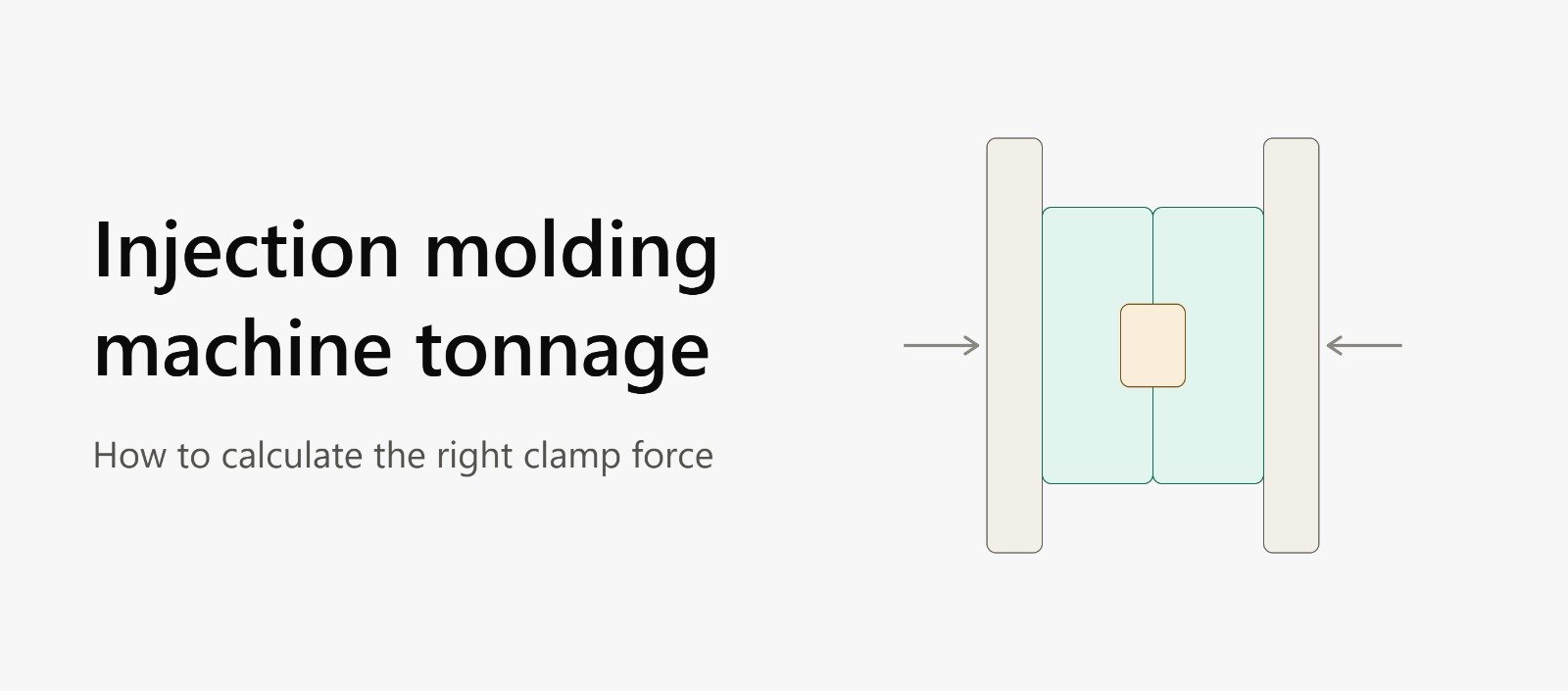
In injection molding, tonnage refers to the clamping force of the machine.
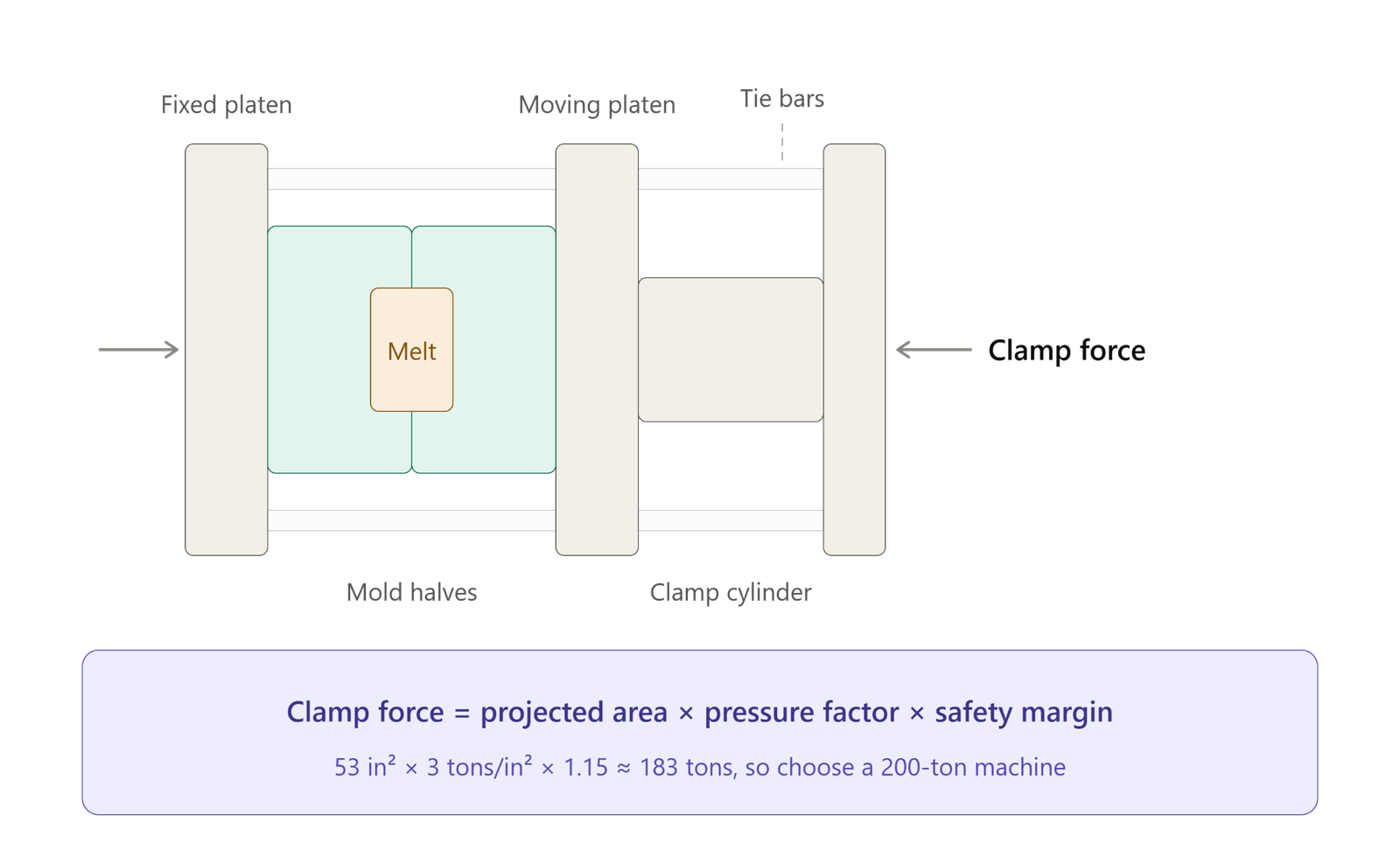
The clamping unit holds the two halves of the mold together while molten plastic is injected into the mold cavity.
For example, a machine described as:
- 100-ton machine
- 200-ton machine
- 500-ton machine
- 1000-ton machine
is generally referring to its approximate clamping-force capacity.
The required tonnage depends primarily on the projected area of the molded product and the pressure generated during injection.
Why Is Clamping Force Important?
During injection, molten plastic is pushed into the mold under pressure.
This pressure creates a force that attempts to separate the mold halves.
The clamping system must generate enough force to resist this force.
If clamping force is insufficient:
- Mold separation may occur
- Flash can develop around the product
- Product dimensions may become inconsistent
- Mold damage can potentially occur
- Production quality can suffer
Therefore, selecting sufficient clamping force is essential for stable production.
What Is Projected Area?
Projected area is the area of the molded product that is effectively exposed to the injection pressure in the direction of mold opening.
For a simple flat rectangular product:
Projected Area = Length × Width
For example:
If a product has:
Length = 200 mm
Width = 100 mm
Then:
Projected Area = 200 × 100 = 20,000 mm²
For multi-cavity molds, the projected area of all cavities and relevant runner areas should be considered.
Basic Injection Molding Tonnage Calculation
A commonly used preliminary approach is:
Required Clamping Force = Projected Area × Clamping Pressure Factor
The exact factor depends on the plastic material, product design, injection pressure, flow characteristics and mold conditions.
A simplified engineering estimate is often expressed using a suitable pressure factor to determine the required clamping force.
Example
Suppose the total projected area of a mold is:
300 cm²
If the selected application requires an estimated clamping-pressure factor of:
0.4 tons/cm²
Then:
Required Clamping Force = 300 × 0.4
= 120 tons
In practice, the next suitable machine size would be evaluated rather than selecting a machine exactly at the calculated minimum.
Important: Tonnage calculations are application-specific. Material, mold design, cavity number, runner system and actual processing conditions should be considered before final machine selection.
Factors That Affect Injection Molding Machine Tonnage
Tonnage is not determined by product size alone.
Several factors can influence the required clamping force.
1. Product Projected Area
A larger projected area generally requires greater clamping force.
2. Number of Cavities
A mold with multiple cavities increases the total projected area.
For example:
A 4-cavity mold will generally require consideration of the projected area of all four cavities.
3. Plastic Material
Different materials have different flow and processing characteristics.
Materials requiring higher injection pressure may influence the required clamping force.
4. Product Design
Thin-wall products, complex geometries and long flow paths may require different processing conditions compared with simple products.
5. Runner System
The runner system also contributes to the projected area and should be considered when estimating clamping requirements.
6. Injection Pressure
Higher injection pressure can increase the force attempting to separate the mold.
7. Safety Margin
Manufacturers generally consider an appropriate safety margin when selecting the machine to account for variations in processing conditions.
Example of Tonnage Calculation
Let's consider a simple example.
Suppose you have a product with:
- Length: 150 mm
- Width: 100 mm
- Number of cavities: 4
Step 1: Calculate projected area of one cavity
150 × 100 = 15,000 mm²
Step 2: Calculate total cavity area
15,000 × 4 = 60,000 mm²
This equals:
600 cm²
The runner system may add additional projected area.
After applying the appropriate clamping-pressure factor for the material and application, the required machine tonnage can be estimated.
The final machine should then be selected based on the available machine sizes and complete mold requirements.
Don't Select a Machine Based on Tonnage Alone
Tonnage is important, but it is only one part of machine selection.
A machine may have sufficient clamping force but still be unsuitable for a particular mold.
Manufacturers should also check:
Injection Capacity
Can the machine provide enough shot capacity for the product, runners and required process conditions?
Mold Dimensions
Will the mold fit within:
- Tie-bar spacing
- Mold thickness range
- Maximum mold height
- Opening stroke
Ejection System
Does the machine provide suitable ejector force and stroke?
Injection Pressure
Can the injection unit provide the pressure required for the selected material and product?
Injection Speed
Is the machine fast enough for the required molding process?
Tonnage vs Injection Capacity
These two specifications are sometimes confused.
Tonnage
Refers primarily to the machine's clamping force.
Injection Capacity
Refers to how much molten plastic the injection unit can deliver under the specified conditions.
A machine needs both:
Sufficient Clamping Force + Suitable Injection Capacity
For example, a machine may have adequate tonnage but insufficient shot capacity for a particular product.
Therefore, both specifications must be evaluated together.
What Happens If You Choose Too Little Tonnage?
Selecting a machine with insufficient clamping force can cause several problems.
Flash
The mold may separate slightly during injection, allowing plastic to escape along the parting line.
Dimensional Problems
Mold movement can affect product dimensions and consistency.
Mold Stress
Repeated mold separation can place unnecessary stress on the mold and machine.
Unstable Production
Operators may need to adjust processing parameters to compensate, potentially affecting cycle time and product quality.
What Happens If You Choose Too Much Tonnage?
More tonnage is not automatically better.
An unnecessarily large machine can result in:
- Higher purchase cost
- Greater energy requirements
- Larger machine footprint
- Higher operating costs
- Potentially less efficient production
The goal is to select a machine that provides adequate clamping force with the appropriate injection capacity and machine configuration.
How to Select the Right Injection Molding Machine
A proper machine-selection process should consider:
Step 1: Understand the Product
Determine:
- Product dimensions
- Product weight
- Material
- Wall thickness
- Design complexity
Step 2: Determine Mold Requirements
Check:
- Number of cavities
- Mold dimensions
- Mold weight
- Runner system
- Required opening stroke
Step 3: Calculate Projected Area
Calculate the projected area of the cavities and relevant runner system.
Step 4: Estimate Required Clamping Force
Use the appropriate engineering calculation based on material and application conditions.
Step 5: Check Injection Capacity
Confirm that the injection unit can provide the required shot size and processing performance.
Step 6: Compare Available Machine Sizes
Select an appropriate machine size with adequate capacity rather than simply choosing the largest available machine.
Step 7: Consider Production Requirements
Evaluate:
- Cycle time
- Production volume
- Automation
- Energy efficiency
- Machine controls
- Maintenance
- After-sales service
How Many Tons Do You Need for Different Products?
There is no universal tonnage range for a particular product category because the required machine size depends on the product dimensions, mold design, cavity count, material and processing conditions.
For example, two manufacturers producing different types of containers may require completely different machine sizes even if both products are categorized as "plastic containers."
Therefore, machine selection should always be based on the actual mold and product specifications.
Injection Molding Machine Tonnage and Multi-Cavity Molds
Multi-cavity molds can significantly increase the required clamping force.
For example, consider a mold with:
1 cavity → projected area = 100 cm²
If the mold has 8 cavities:
100 × 8 = 800 cm²
The total projected area has increased substantially.
The runner system must also be considered.
This is why manufacturers should provide complete mold information when discussing machine selection with an injection molding machine manufacturer.
Tonnage and Thin-Wall Injection Molding
Thin-wall products can require higher injection speeds and pressure to fill the cavity before the material cools.
Applications such as:
- Food containers
- Packaging
- Disposable products
- Thin-wall household products
may require specialized machine configurations.
In these applications, manufacturers should consider clamping force, injection speed, injection pressure and cycle time together rather than focusing only on tonnage.
Why Accurate Machine Selection Matters
Correct machine selection can help manufacturers achieve:
- Stable production
- Consistent product quality
- Better cycle times
- Reduced material waste
- Efficient energy usage
- Lower operating costs
- Longer machine life
- Better production planning
A properly selected plastic injection molding machine should match both the mold and the manufacturing requirements.
Injection Molding Machine Tonnage Checklist
Before selecting a machine, check:
☑ Product projected area
☑ Number of cavities
☑ Runner projected area
☑ Plastic material
☑ Required injection pressure
☑ Required clamping force
☑ Mold dimensions
☑ Mold weight
☑ Injection capacity
☑ Injection speed
☑ Ejection requirements
☑ Cycle time
☑ Production volume
☑ Automation requirements
☑ Energy efficiency
☑ Service and spare-parts support
Conclusion
Injection molding machine tonnage is an essential factor when selecting a machine, but it should never be considered in isolation.
The correct machine depends on the combination of:
Product + Mold + Material + Projected Area + Cavities + Injection Pressure + Production Requirements
A machine with insufficient clamping force can create production and quality problems, while an unnecessarily large machine can increase investment and operating costs.
For this reason, manufacturers should calculate the required clamping force and then evaluate the complete machine specification before making a purchase.
If you are looking for an injection molding machine manufacturer to help evaluate your product and mold requirements, Boss Automation can help you identify a suitable machine configuration for your production application.
Frequently Asked Questions
1. What does tonnage mean in an injection molding machine?
Tonnage generally refers to the clamping force available to keep the mold closed during the injection process.
2. How do I calculate injection molding machine tonnage?
A preliminary calculation generally considers the total projected area of the molded product and runner system along with an appropriate clamping-pressure factor for the application.
3. Does more tonnage mean a better machine?
No. The machine should have sufficient clamping force for the application. Excessive tonnage can increase machine cost and operating expenses.
4. Does the number of cavities affect machine tonnage?
Yes. More cavities generally increase the total projected area and can therefore increase the required clamping force.
5. Does plastic material affect required tonnage?
Yes. Different materials have different processing characteristics and injection-pressure requirements, which can influence clamping-force requirements.
6. Is tonnage the only factor when selecting an injection molding machine?
No. Injection capacity, mold dimensions, injection pressure, injection speed, cycle time, material, automation, energy efficiency and after-sales support should also be considered.