
B
O
S
S
A
U
T
O
M
A
T
I
O
N
Loading
Blogs
30
Jun
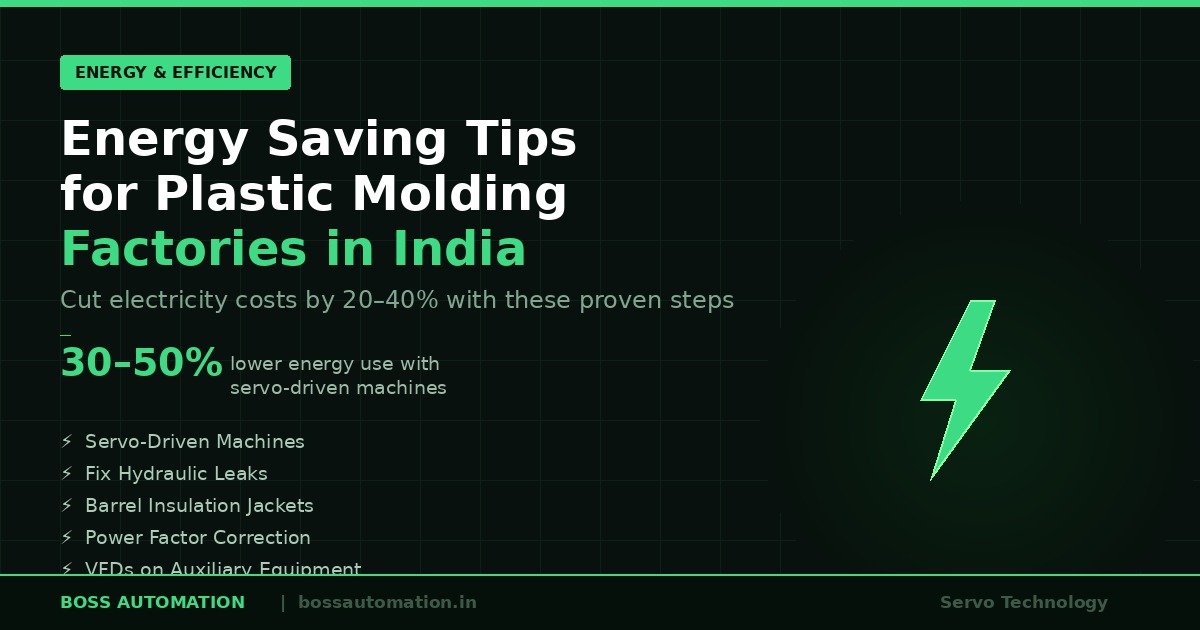
Energy Saving Tips for Plastic Molding Factories in India
Electricity is one of the largest recurring costs in plastic moulding — often second only to raw material. With industrial power tariffs across Gujarat, Maharashtra, and other manufacturing states ranging from ₹7–11 per unit, a single 200-tonne machine running 20 hours a day can rack up ₹3–4 lakh in electricity costs every month.
The good news: a large share of this cost is avoidable. Most factories are losing 15–40% of their energy spend to inefficiencies that are simple to fix once you know where to look.
Here are practical, proven energy-saving strategies Indian moulding factories can implement — some free, some requiring investment, all with measurable payback.
1. Switch to Servo-Driven Machines
This is the single biggest lever available. Conventional hydraulic machines run the motor and pump at constant speed regardless of actual demand — wasting energy during idle, cooling, and holding phases.
Servo-hydraulic machines adjust motor speed in real time to match actual demand, cutting energy consumption by 30–50% compared to fixed-speed hydraulic systems.
| Machine Type | Avg. Power Draw (200T) | Daily Cost (20 hrs, ₹9/unit) | Annual Cost |
| Conventional Hydraulic | ~20 kW/hr | ₹3,600 | ₹13.1 lakh |
| Servo-Hydraulic | ~10 kW/hr | ₹1,800 | ₹6.6 lakh |
| Annual Savings | ₹6.5 lakh |
For factories running multiple machines, retrofitting or replacing even 2–3 of your oldest hydraulic units with servo machines can pay back the investment in 18–30 months purely through energy savings.
2. Fix Hydraulic Oil Leaks and Pump Wear
A worn hydraulic pump or leaking valve forces the system to work harder to maintain pressure — silently increasing your energy bill.
Action items:
- Inspect pump and valve blocks monthly for leaks
- Replace worn seals immediately rather than “monitoring” them
- Check hydraulic oil viscosity — degraded oil increases internal friction and pump load
- Keep oil temperature within the manufacturer’s recommended range (typically 40–50°C)
A pump operating at 80% efficiency instead of 95% can add 15–20% to your machine’s energy draw — often without any visible symptoms.
3. Right-Size Your Machine Tonnage
Running an oversized machine for a small part is one of the most common — and costly — mistakes in Indian moulding factories.
A 250-tonne machine running a part that only needs 120 tonnes still draws power for systems sized for the larger capacity: bigger pump, larger heaters, higher base hydraulic pressure.
What to do:
- Audit your machine-to-mould matching across your shop floor
- Move small parts to your smallest suitable machine
- When buying new machines, size for your actual part range — not “just in case” future capacity
4. Optimize Barrel Heating
Barrel heating typically accounts for 20–30% of total machine energy consumption.
Reduce heating losses with:
- Barrel insulation jackets — can reduce heating energy by 15–25% by minimizing heat radiated into the surrounding air
- PID-tuned temperature controllers — prevent overshoot and unnecessary reheating cycles
- Scheduled startup/shutdown — avoid keeping barrels at full temperature during long idle periods (lunch breaks, shift changes)
A barrel insulation jacket costs roughly ₹15,000–₹40,000 per machine depending on size, and typically pays for itself within 6–12 months through reduced heater run-time.
5. Reduce Cycle Time Through Better Cooling
Inefficient mould cooling extends cycle time, which means the machine — and every system attached to it — runs longer per part than necessary.
Improve cooling efficiency by:
- Verifying mould cooling channels aren’t blocked with scale or rust (use a chiller water test annually)
- Using a properly sized chiller — undersized chillers struggle to remove heat fast, extending cooling time
- Maintaining correct water flow rate and temperature differential (ΔT) across the mould
- Considering conformal cooling channels for new mould designs on high-volume parts
Even a 2-second cycle time reduction across 20 hours of daily production can add up to thousands of extra shots per month — using the same amount of energy per hour but producing more parts in that time.
6. Address Compressed Air Leaks
Many factories overlook compressed air as an energy cost, but air leaks are notoriously expensive. A single 3mm leak in a compressed air line can cost over ₹25,000 per year in wasted electricity.
Quick wins:
- Conduct a monthly “listen and feel” leak check during a quiet period
- Tag and repair leaking fittings, hoses, and quick-connects immediately
- Install a dedicated air leak detection check as part of your maintenance schedule
7. Install Power Factor Correction Capacitors
Many factories pay a power factor penalty on their electricity bill without realizing it. Industrial connections in Gujarat (and most states) penalize power factor below 0.90–0.95.
Installing PFC capacitor banks can:
- Eliminate or reduce low power factor penalties
- Improve voltage stability across your shop floor
- Reduce transformer and cable losses
This is often one of the fastest-payback investments available — many factories recover the capacitor bank cost within 6–10 months purely from penalty elimination.
8. Use Variable Frequency Drives (VFDs) on Auxiliary Equipment
Energy savings shouldn’t stop at the moulding machine itself. Auxiliary equipment often runs at full speed regardless of actual load:
- Chillers — VFDs adjust compressor speed to actual cooling demand
- Cooling tower fans — reduce speed during lower ambient temperature periods
- Air compressors — match output to actual plant air demand instead of running at fixed capacity
VFD retrofits on auxiliary equipment typically deliver 20–35% energy savings on that equipment specifically.
9. Schedule Production During Off-Peak Hours (Where Applicable)
Some Indian states offer Time-of-Day (ToD) tariffs with lower rates during off-peak hours (typically late night/early morning).
If your state offers ToD tariffs:
- Shift non-urgent, longer production runs to off-peak windows where feasible
- Coordinate with your electricity board to understand your specific ToD slab structure
- This works particularly well for factories already running night shifts
Check with your local DISCOM (e.g., PGVCL, UGVCL in Gujarat) for current ToD tariff structures applicable to your connection category.
10. Conduct a Professional Energy Audit
You can’t optimize what you don’t measure. A professional energy audit identifies exactly where your factory is losing money — often revealing savings opportunities owners didn’t know existed.
A good energy audit typically covers:
- Machine-by-machine power consumption mapping
- Power factor and harmonics analysis
- Compressed air and chiller system efficiency
- Lighting and HVAC consumption
- Peak demand patterns and potential demand charge reduction
Many Indian states offer subsidized energy audits through agencies like the Bureau of Energy Efficiency (BEE) or state-level industrial development corporations — worth checking before paying full price for a private audit.
Quick Reference: Energy Saving Checklist
✅ Evaluate servo-hydraulic machines for highest-usage units ✅ Inspect hydraulic pumps and seals monthly for leaks ✅ Match machine tonnage to actual part requirements ✅ Add barrel insulation jackets where missing ✅ Audit and optimize mould cooling efficiency ✅ Check compressed air lines for leaks monthly ✅ Install power factor correction capacitors ✅ Add VFDs to chillers, cooling towers, and compressors ✅ Explore ToD tariff scheduling opportunities ✅ Get a professional energy audit done annually
The Bottom Line
Energy efficiency in plastic moulding isn’t a single fix — it’s a combination of machine technology, maintenance discipline, and operational scheduling. Factories that take a systematic approach typically see 20–40% reduction in energy costs within the first year, often without major capital investment.
The single highest-impact decision remains your choice of machine technology. If you’re still running older conventional hydraulic machines on your highest-volume jobs, that’s usually where the biggest savings are waiting.
How Boss Automation Can Help
Our servo-driven injection moulding machines are engineered specifically for energy efficiency, delivering 30–50% lower power consumption compared to conventional hydraulic systems — without compromising on speed or precision. We also offer:
- Free energy consumption assessments for your existing machines
- Servo retrofit consultations
- Guidance on the right machine specification for energy-conscious production
Suggested Meta Description: Cut your plastic moulding factory’s electricity bill by 20–40%. Practical energy-saving tips for Indian manufacturers — from servo machines to power factor correction.
Suggested Tags: energy saving injection moulding, servo machine India, plastic factory electricity, power factor correction, ToD tariff, Boss Automation