B
O
S
S
A
U
T
O
M
A
T
I
O
N
Loading
Blogs
30
May
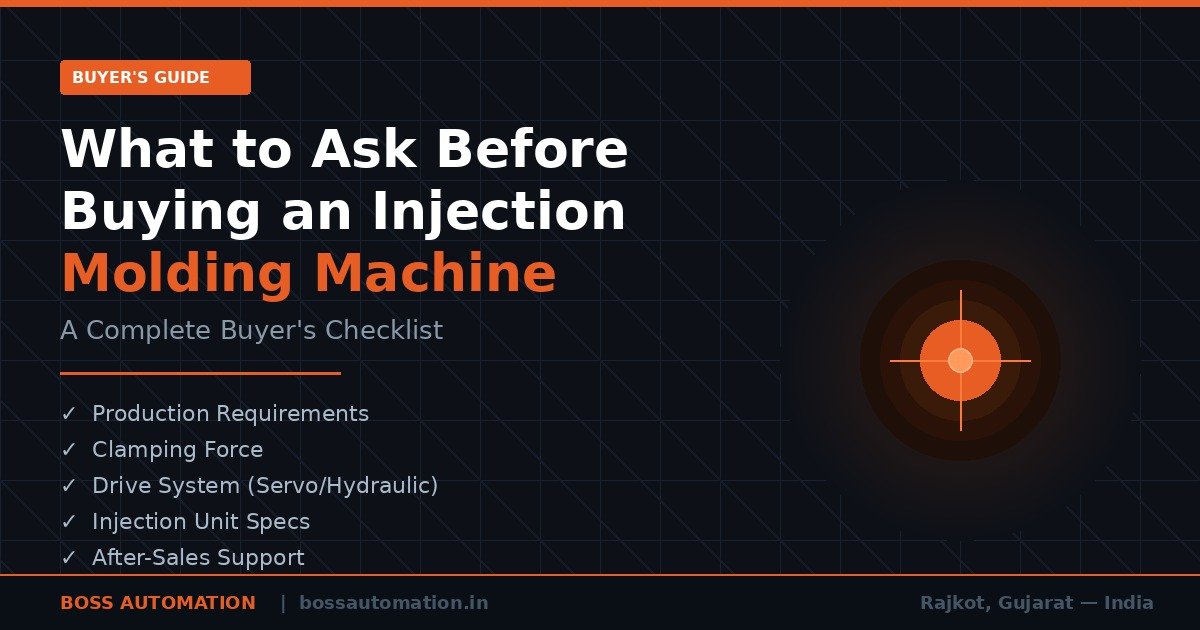
What to Ask Before Buying a Plastic Injection Molding Machine
Buying a plastic injection molding machine is one of the biggest capital investments a manufacturer can make. Whether you’re setting up a new facility or upgrading an existing one, the wrong choice can cost you years of lost productivity, high energy bills, and expensive maintenance headaches.
This checklist is designed to help Indian manufacturers — from small job shops in Gujarat to large OEM facilities in Pune — ask the right questions before signing the purchase order.
1. What Are Your Production Requirements?
Before you even speak to a supplier, get clarity on your own needs.
- What material will you process? PP, ABS, PET, Nylon, PC, or engineering-grade polymers all have different melt temperature and pressure requirements.
- What is your target shot weight? Shot weight determines the minimum machine tonnage you need.
- What is your expected cycle time? Faster cycles demand a machine with quick response hydraulics or full servo systems.
- What is your projected production volume per day/month? This affects machine duty cycle and uptime requirements.
Pro tip: Don’t just plan for today’s orders. Factor in 20–30% growth in the next 3 years so you don’t outgrow your machine too soon.
2. What Clamping Force Do You Need?
Clamping force (measured in tonnes) is one of the most critical specs to get right.
Ask yourself:
- What is the projected area of your largest part?
- What cavity pressure does your material require?
- Will you be running multi-cavity moulds?
Formula to estimate:
Clamping Force (tonnes) = Projected Area (cm²) × Cavity Pressure (kg/cm²) ÷ 1000
Undersizing clamping force leads to flash defects and mould damage. Oversizing means wasted energy and higher upfront cost.
3. Hydraulic, Servo, or All-Electric — Which Drive System?
This is the question that most buyers underestimate.
| Drive Type | Best For | Energy Efficiency | Precision |
| Hydraulic | Heavy tonnage, rugged use | Moderate | Good |
| Servo-Hydraulic | Mixed production, mid-volume | High (30–60% savings) | Very Good |
| All-Electric | Medical, packaging, clean room | Highest | Excellent |
Key questions to ask the supplier:
- What is the energy consumption (kW) at full load vs idle?
- Does the servo motor come with a brand-name drive (Siemens, Delta, Mitsubishi)?
- What is the typical energy saving % compared to a standard hydraulic machine?
Boss Automation’s servo machines deliver up to 50% energy savings over conventional hydraulic systems — ask for a comparative data sheet.
4. What Is the Machine’s Injection Unit Capacity?
The injection unit directly impacts part quality. Ask for:
- Injection capacity (cm³) — maximum volume per shot
- Injection pressure (bar/kg/cm²) — needed for thin-wall or high-viscosity materials
- Injection speed (mm/s) — critical for packaging and thin-wall applications
- Plasticising rate (kg/hr) — impacts cycle time for high-volume production
- Screw L/D ratio — longer screws give better melt homogeneity; typical range is 20:1 to 22:1
5. Ask About Mould Compatibility
Your new machine is only as useful as the moulds you can run on it.
- What is the minimum and maximum mould height (daylight)?
- What is the tie-bar spacing? Your mould must fit between the tie bars.
- What is the platen size? Larger platens allow bigger moulds.
- What is the ejection stroke and ejection force? Especially important for deep-draw parts.
Always bring your existing mould drawings when meeting a supplier. A reputable manufacturer will confirm compatibility on paper before you pay a rupee.
6. What Control System Does It Use?
The machine controller is the brain of your operation. Poor software leads to inconsistent parts.
Ask:
- Which PLC/controller brand is used? (Common: Keba, Siemens, Barco, Moog)
- Is the HMI touchscreen with recipe storage?
- Can you store multiple product programs?
- Does it support process monitoring and data logging?
- Is remote diagnostics or IoT connectivity available?
- Is the software available in Hindi or other Indian languages?
A modern controller should allow you to replicate settings perfectly across shifts — reducing operator dependency and improving consistency.
7. What Are the After-Sales Service Terms?
This is where many buyers make costly mistakes. Low machine price + poor service = high total cost of ownership.
Questions you must ask:
- Where is the nearest service centre? What is the average response time in your state?
- Is there a dedicated service engineer for your region?
- What is the warranty period on the machine and its components?
- Are spare parts (hydraulic seals, heating bands, solenoid valves) available in India?
- What is the average lead time for spare parts?
- Do you offer Annual Maintenance Contracts (AMC)?
Boss Automation offers dedicated after-sales support with service engineers across Gujarat and pan-India. Ask about our AMC packages.
8. What Is the Total Cost of Ownership (TCO)?
The machine’s sticker price is only one part of the equation.
Calculate TCO over 5 years, including:
| Cost Head | What to Estimate |
| Purchase price | Machine + GST + transport |
| Installation & commissioning | Civil work, electrical, trial runs |
| Energy costs | Units/hr × operating hours × ₹/unit |
| Maintenance & spares | Annual average |
| Operator training | Initial + refreshers |
| Downtime cost | Avg downtime days × production loss |
A servo machine that costs ₹3–5 lakh more upfront can save ₹8–12 lakh in electricity alone over 5 years.
9. What Certifications and Compliance Does the Machine Meet?
For buyers supplying to automotive, medical, or export markets, compliance is non-negotiable.
Ask for:
- CE certification (mandatory for European export)
- BIS certification (if applicable)
- ISO 9001 quality management compliance from the manufacturer
- Electrical safety certification (IE/UL/IEC standards)
- Environment compliance (noise levels, hydraulic oil containment)
10. Can You See It Run Before You Buy?
Never buy blind. A machine demonstration is your right as a buyer.
Request:
- A live trial run at the manufacturer’s facility
- A run with your own mould and material, if possible
- Cycle time verification against the quoted specs
- Noise and vibration check during operation
- Review of process parameter screen and ease of operation
Reputable manufacturers like Boss Automation welcome factory visits. If a supplier refuses a demo, treat it as a red flag.
Quick Reference: Buyer’s Checklist Summary
✅ Define shot weight, cycle time, and material requirements
✅ Calculate required clamping force correctly
✅ Choose between hydraulic, servo, or all-electric based on energy and precision needs
✅ Verify injection unit specs match your application
✅ Confirm mould compatibility (tie-bar, platen, daylight)
✅ Evaluate the controller and software features
✅ Inspect after-sales support and spare parts availability
✅ Calculate total cost of ownership over 5 years
✅ Check certifications relevant to your industry
✅ Insist on a live machine demonstration
Conclusion
Buying a plastic injection molding machine is not just about the lowest price. It’s about finding the right machine for your application, from a manufacturer who will support you long after the machine is installed.
At Boss Automation, we work closely with buyers to recommend the right machine specification — whether you’re processing PET preforms, automotive components, or everyday consumer goods. Our team of engineers is available for no-obligation consultations.