B
O
S
S
A
U
T
O
M
A
T
I
O
N
Loading
Blogs
30
Jun
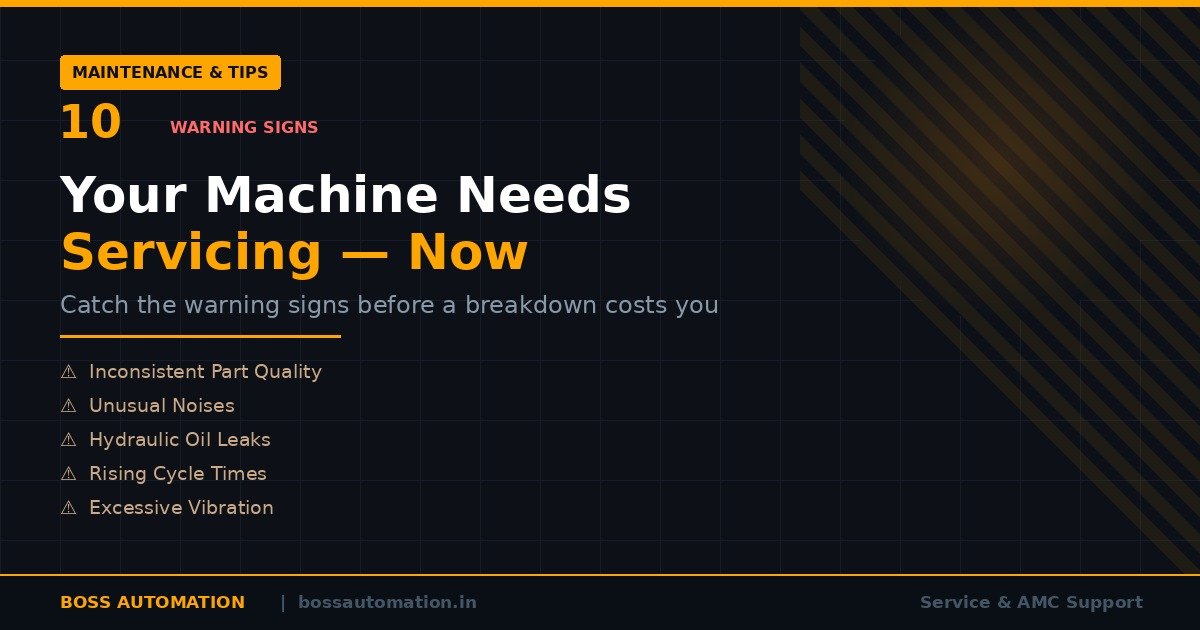
10 Signs Your Injection Moulding Machine Needs Servicing
Every injection moulding machine gives warning signs before a major breakdown. The problem is most operators only notice them once production is already affected — a rejected batch, a sudden stoppage, or worse, a damaged mould.
The good news: most of these warning signs are easy to spot if you know what to look for. Catching them early can save you lakhs in repair costs and prevent costly downtime.
Here are the 10 signs that tell you it’s time to call for servicing — before a small issue becomes a big one.
1. Inconsistent Part Quality
If parts that used to come out perfect are now showing flash, short shots, sink marks, or warping — without any change in material or mould — your machine is telling you something.
Likely causes: Worn screw/barrel, inconsistent injection pressure, deteriorating non-return valve, or temperature control drift.
What to do: Don’t just adjust process parameters to “compensate.” Get the injection unit inspected — masking a mechanical problem with software tweaks only delays the real fix.
2. Unusual Noises During Operation
A healthy injection moulding machine has a predictable sound pattern. Pay attention if you hear:
- Knocking or banging during clamping — often a sign of worn toggle links or loose tie-bar nuts
- Whining or screeching from the hydraulic pump — indicates pump wear or air in the system
- Grinding from the screw — usually points to barrel or screw wear, or foreign material contamination
Pro tip: Train your operators to recognise “normal” machine sound during commissioning. Any deviation should be reported immediately, not after a week.
3. Hydraulic Oil Leaks or Discoloration
Hydraulic oil should be clear to light amber. Check for:
- Leaks at cylinder seals, hose fittings, or valve blocks
- Dark or milky oil — indicates contamination, overheating, or water ingress
- Burnt smell — a sign the oil has overheated, often due to pump strain or low oil level
Hydraulic oil should typically be changed every 2,000–4,000 operating hours, but inspect it monthly regardless of schedule.
4. Rising Cycle Times
If your cycle time has crept up — even by a few seconds — without any process changes, the machine is working harder than it should.
Common causes:
- Reduced hydraulic pump efficiency
- Heater band degradation (slower heating recovery)
- Valve response delay
- Cooling system inefficiency (mould or oil cooler)
A 3–5 second increase per cycle may seem trivial, but multiplied across thousands of daily shots, it adds up to significant lost output and higher energy costs.
5. Temperature Fluctuations on the Barrel
Your barrel zones should hold setpoint temperature within ±2°C. If you’re seeing wider swings:
- Check heater bands for wear or burnout
- Inspect thermocouples for accuracy drift
- Verify the temperature controller (PID) is tuned correctly
Inconsistent barrel temperature directly causes inconsistent melt quality — leading to part defects that are hard to diagnose if you’re only looking at the mould side.
6. Excessive Vibration
A well-maintained machine should run smoothly with minimal vibration. If you notice the machine shaking more than usual:
- Check mounting bolts and levelling pads
- Inspect for worn bearings in the clamping unit
- Verify tie-bar tension is even across all four bars
Excessive vibration accelerates wear on every other component — it’s often the first visible sign of a developing mechanical issue.
7. Increase in Energy Consumption
If your electricity bill per tonne of production is creeping up, your machine’s hydraulic or servo system may be losing efficiency.
What typically causes this:
- Hydraulic pump wear (working harder to maintain pressure)
- Valve leakage (internal bypass losses)
- Motor or servo drive degradation
Track your kWh-per-shift figures monthly. A gradual increase — even 5–10% — is worth investigating before it becomes 30%.
8. Mould Doesn’t Close or Open Smoothly
Smooth, consistent clamping motion is critical for part quality and mould life.
Watch for:
- Hesitation or jerking during mould close/open
- Uneven closing across the platen (visible misalignment)
- Increased force needed to achieve full lock-up
This is often linked to toggle mechanism wear, tie-bar elongation, or platen guide bushing wear — all of which worsen quickly if ignored.
9. Error Codes or Alarms Appearing More Frequently
Modern controllers (Keba, Siemens, Barco) are designed to flag issues before they become failures. If you’re seeing:
- Repeated low-pressure alarms
- Position sensor faults
- Temperature deviation warnings
- Intermittent communication errors
…don’t just reset and continue. Log every alarm with date, time, and what was happening on the machine. Patterns in these logs often point straight to the root cause.
10. It’s Simply Been a While
Even if nothing seems wrong, preventive maintenance schedules exist for a reason. As a general guide:
| Maintenance Task | Recommended Frequency |
| Hydraulic oil & filter check | Monthly |
| Hydraulic oil change | Every 2,000–4,000 hours |
| Barrel & screw inspection | Every 6 months or 5,000 hours |
| Tie-bar tension check | Every 6 months |
| Electrical/control panel inspection | Every 6 months |
| Full machine overhaul/AMC visit | Annually |
Machines running 2–3 shifts/day accumulate wear far faster than calendar time suggests. If it’s been over a year since your last full service, it’s overdue — regardless of how “fine” it seems.
Why Early Servicing Saves You Money
Manufacturers often delay servicing to avoid production downtime — but this almost always backfires.
| Preventive Servicing | Reactive Repair (after failure) | |
| Average cost | ₹15,000–₹50,000 | ₹1,00,000–₹5,00,000+ |
| Downtime | Few hours (planned) | Days (unplanned) |
| Part quality impact | None | Rejected batches, customer complaints |
| Mould damage risk | Low | High (if clamping/alignment fails) |
A planned half-day service visit is always cheaper than an emergency breakdown that halts your production line for days.
How Boss Automation Can Help
Boss Automation offers Annual Maintenance Contracts (AMC) and on-call servicing for all our machines — and we’re happy to inspect machines from other manufacturers too.
Our service includes:
- Full hydraulic system inspection and oil analysis
- Screw and barrel wear measurement
- Electrical and control panel diagnostics
- Tie-bar and clamping unit alignment check
- Energy efficiency audit with savings recommendations
Catching these 10 signs early means fewer surprises, lower repair bills, and consistent part quality — exactly what your production schedule depends on.
Suggested Meta Description: Don’t wait for a breakdown. Learn the 10 warning signs your injection molding machine needs servicing — from noise and vibration to rising cycle times and energy bills.
Suggested Tags: injection moulding machine maintenance, machine servicing, hydraulic oil, preventive maintenance, AMC, Boss Automation