B
O
S
S
A
U
T
O
M
A
T
I
O
N
Loading
Blogs
30
May
New vs. Used Injection Molding Machine: What Indian Manufacturers Should Know
New vs. Used Injection Molding Machine: What Indian Manufacturers Should Know
You’ve decided to expand your plastic moulding capacity. The budget is approved. Now comes the question every factory owner in India wrestles with:
Should I buy a new machine — or save money with a used one?
It sounds like a simple cost decision. But for Indian manufacturers, the answer involves much more than the purchase price. It involves spare parts availability, energy costs, GST input credit, productivity loss from downtime, and whether the machine will last long enough to justify the investment.
This article breaks it all down — so you can make a decision your accountant and your production manager will agree on.
The Appeal of Used Machines — And Why Buyers Get Burned
Used injection moulding machines are everywhere in India. You’ll find them at auctions in GIDC Vatva, through brokers in Rajkot, and on platforms like IndiaMART. Prices can be 40–70% lower than a comparable new machine.
That’s genuinely attractive — especially for:
- First-time buyers testing a new product line
- Small job shops with tight capital budgets
- Manufacturers who need a backup machine quickly
But here’s the uncomfortable truth: a significant percentage of used machine buyers in India end up spending more than they saved — on repairs, retrofits, production losses, and eventually a replacement machine.
Why? Because most used machines are sold without full disclosure of their actual condition.
The Hidden Costs of a Used Machine
Before you commit to a “great deal” on a second-hand machine, add up the real numbers:
1. Hydraulic System Wear
Hydraulic seals, pump vanes, and valves degrade with age and use. A machine that has run 3 shifts/day for 8 years has hydraulic components that may be at or near end-of-life. Replacing a hydraulic pump alone can cost ₹40,000–₹1,20,000. A full hydraulic overhaul can exceed ₹3–5 lakh.
2. Barrel and Screw Wear
The screw and barrel are the heart of the plasticising unit. Worn screws produce inconsistent melt, rejected parts, and higher material wastage. Replacing a screw-barrel set typically costs ₹80,000–₹3,00,000 depending on machine size and material.
3. Outdated Control Systems
Many used machines running in India still have old relay-based or early PLC controls. Replacing a controller costs ₹1.5–4 lakh — and sometimes the new controller isn’t compatible with the existing wiring architecture without a full electrical retrofit.
4. Energy Inefficiency
A 10-year-old conventional hydraulic machine can consume 30–60% more energy than a modern servo machine of the same tonnage. At ₹8–10/unit electricity cost and 20-hour daily operation, that’s an extra ₹3–8 lakh per year in electricity alone.
5. No Warranty, No Service Network
Most used machines are sold as-is. When something breaks — and it will — you’re on your own. Downtime during a critical production run is not just a repair cost; it’s a penalty clause, a lost customer, and a missed deadline.
What a New Machine Actually Costs You (And What It Saves)
A new injection moulding machine from a reputable Indian manufacturer like Boss Automation is priced competitively — often within reach once you account for financing, GST ITC, and energy savings.
GST Input Tax Credit
New machines purchased for business use attract 18% GST — but this is fully recoverable as Input Tax Credit (ITC) for GST-registered businesses. A ₹20 lakh machine has ₹3.6 lakh in GST that comes straight back to you. Used machines sold by unregistered parties carry no ITC.
Bank Finance & MSME Schemes
New machines from established manufacturers come with manufacturer-backed documentation, making bank finance straightforward. Under government MSME schemes like CGTMSE, collateral-free loans up to ₹2 crore are available. Used machines often don’t qualify for such schemes.
Energy Savings (Servo Technology)
Boss Automation’s servo-driven machines consume 30–50% less electricity than conventional hydraulic machines. For a 200-tonne machine running 20 hours/day:
| Old Hydraulic Machine | New Servo Machine | |
| Power consumption | ~18–22 kW/hr | ~9–12 kW/hr |
| Daily electricity cost (₹9/unit) | ₹3,240–₹3,960 | ₹1,620–₹2,160 |
| Annual savings | — | ₹5.9–6.5 lakh/year |
Over 5 years, the electricity savings alone can be ₹25–32 lakh — often more than the price difference between new and used.
Warranty & Support
A new Boss Automation machine comes with a comprehensive warranty and access to our pan-India service network. Spare parts are stocked and available with short lead times — no hunting through used parts dealers in Surat or Mumbai.
Side-by-Side Comparison
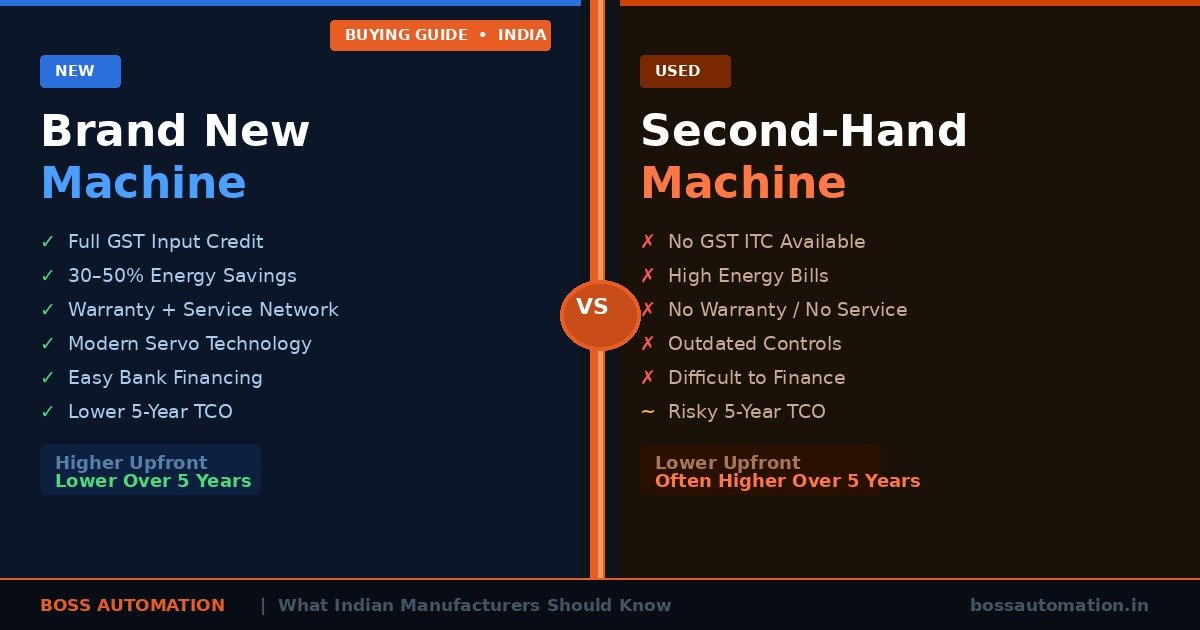
| Parameter | New Machine | Used Machine |
| Purchase price | Higher upfront | 40–70% lower upfront |
| GST Input Credit | Full ITC available | Usually not available |
| Bank financing | Easily available | Difficult to finance |
| Energy efficiency | High (servo/electric) | Often low (old hydraulic) |
| Warranty | Yes — full coverage | None / minimal |
| Spare parts | Standard, readily available | May be obsolete |
| Control system | Modern HMI, recipe storage | Often outdated |
| Downtime risk | Low | High |
| Resale value after 10 yrs | Good | Very low / scrap |
| 5-year TCO | Lower | Often higher |
When a Used Machine Can Make Sense
We’re not saying used machines are always a bad idea. There are legitimate scenarios where they work:
✅ Short-term or pilot projects: If you’re testing a new product line and don’t want to commit full capital, a used machine for 12–18 months can be a calculated risk — provided you budget for repairs.
✅ Simple, low-precision parts: For non-critical commodity parts where quality consistency matters less, an older machine may be acceptable.
✅ You have an in-house maintenance team: If your facility has experienced machine technicians and you can inspect/refurbish the machine yourself, you can extract value from a used machine that others couldn’t.
✅ You’re buying from a known seller with full history: If the machine is from a plant that’s closing and you can verify its actual running hours, maintenance records, and inspection reports — the risk is much lower.
5 Questions to Ask Before Buying a Used Machine
If you do decide to go the used route, protect yourself with due diligence:
- What are the actual running hours and production history? Ask for logbook records, not just the seller’s word.
- Has the screw and barrel been measured for wear? Request a wear report or insist on measurement at purchase.
- When were the hydraulic seals last replaced? Check the hydraulic oil for contamination and colour.
- Who manufactured the machine, and are spares still available? Avoid obscure Chinese or Eastern European brands from the 1990s–2000s where spares are virtually unavailable in India.
- Will you get an inspection run before purchase? Never buy a used machine you haven’t seen run a full production cycle.
The Real Question: What Is Your 5-Year Plan?
This is the most important question, and most buyers skip it.
- If you’re building a serious, growing manufacturing business — a new machine is almost always the better investment over 5 years.
- If you need a stopgap for 12–18 months while capital is tight — a carefully vetted used machine from a known seller may bridge the gap.
- If you’re buying used because you think it’s the “safe” low-risk option — that assumption deserves serious scrutiny.
The lowest purchase price is rarely the lowest total cost.
Why Indian Manufacturers Are Choosing New Boss Automation Machines
At Boss Automation, we manufacture injection moulding machines in Rajkot with full control over quality at every stage. Our machines are:
- Built with branded components (Siemens, Delta, Rexroth)
- Servo-driven for 30–50% energy savings
- Backed by pan-India after-sales service
- Competitively priced for the Indian market
- Eligible for full GST ITC and MSME financing
We offer flexible payment options and work with your CA or banker to structure purchases that make financial sense for your business.
Conclusion
The used vs. new decision is never just about the sticker price. When you factor in energy costs, downtime, GST ITC, financing, and total cost of ownership, a new machine from a quality manufacturer often works out cheaper over a 5-year window — and gives you far fewer headaches along the way.
If you’re weighing your options, our team is happy to run a side-by-side TCO comparison for your specific application — at no cost.
Suggested Meta Description: New vs. used injection molding machine — which is smarter for Indian manufacturers? Compare real costs, GST ITC, energy savings, and 5-year TCO before you decide.
Suggested Tags: injection moulding machine, new vs used machine, plastic machine India, servo injection moulding, MSME machine finance, Boss Automation